 Mostafa Ashraf

Reflected XSS via Self-XSS + CSRF Chain
Hello, in this writeup I’m going to walk through the technique I used to achieve Reflected Cross-Site Scripting (RXSS) by chaining a Self-XSS with CSRF.
Let’s first briefly define XSS and its types before diving into the actual bug.
What is XSS?
Cross-Site Scripting (XSS) is a vulnerability that allows an attacker to inject malicious scripts into trusted web pages, causing them to execute within the victim’s browser session.
Types of XSS:
- Stored XSS: the payload is permanently stored on the server (database, comments, etc.).
- Reflected XSS: the payload is immediately reflected back in the server’s response (search results, error messages, etc.).
- DOM-Based XSS: the vulnerability exists purely in client-side JavaScript, with no server involvement required.
Now let’s get into the actual bug.
Let’s call our target example.com
Recon
I started with some basic recon:
subfinder -d example.com
Going through the results, one subdomain caught my attention: banking.example.com
Discovery
I opened it and created an account. I started by checking the profile page and testing the parameters, injecting simple HTML and XSS payloads to see what would reflect in the page source.
I found a parameter called iban that reflected my input without any sanitization.
So I crafted the following payload:
"><body onpageshow=alert(document.domain)><
Upon saving, the alert fired, as shown in the screenshot below:
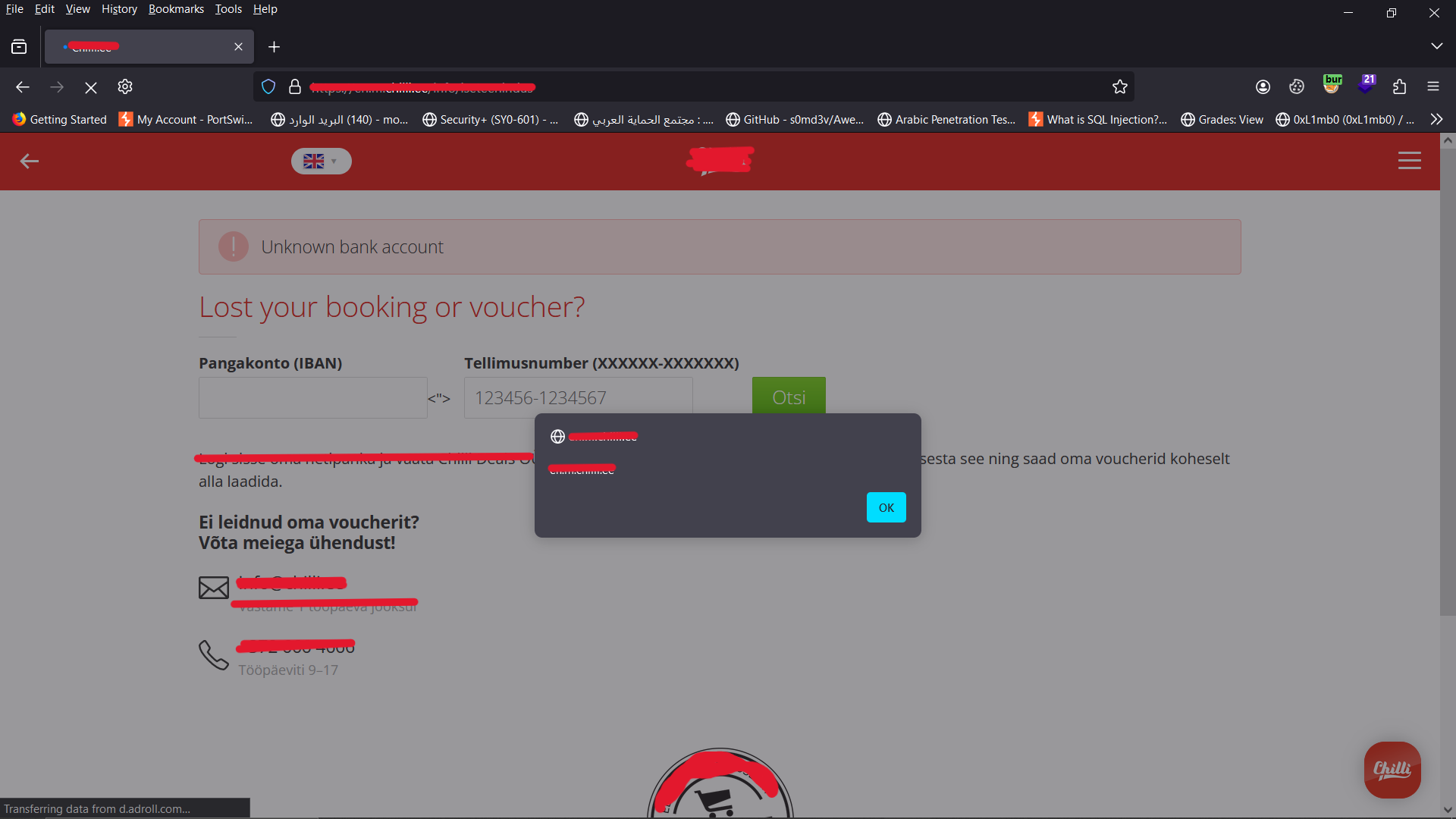
At this point, it was still just a Self-XSS with zero impact on other users.
Escalation
To turn this into a real, impactful vulnerability, I inspected the request further and noticed it had no CSRF token, which gave me the idea to chain it with CSRF.
I opened the request in Burp Suite Pro:
Right click -> Engagement tools -> Generate CSRF PoC
I then hosted the PoC on GitHub Pages. Now, sending this link to a victim causes the JavaScript payload to execute within their authenticated session, effectively escalating the Self-XSS into a fully Reflected XSS.